
Blog
What is Manufacturing Traceability?
Learn what manufacturing traceability is, why it matters, and how MES helps manufacturers improve quality, compliance, and production visibility.
Request FREE Consultation → Explore Traceability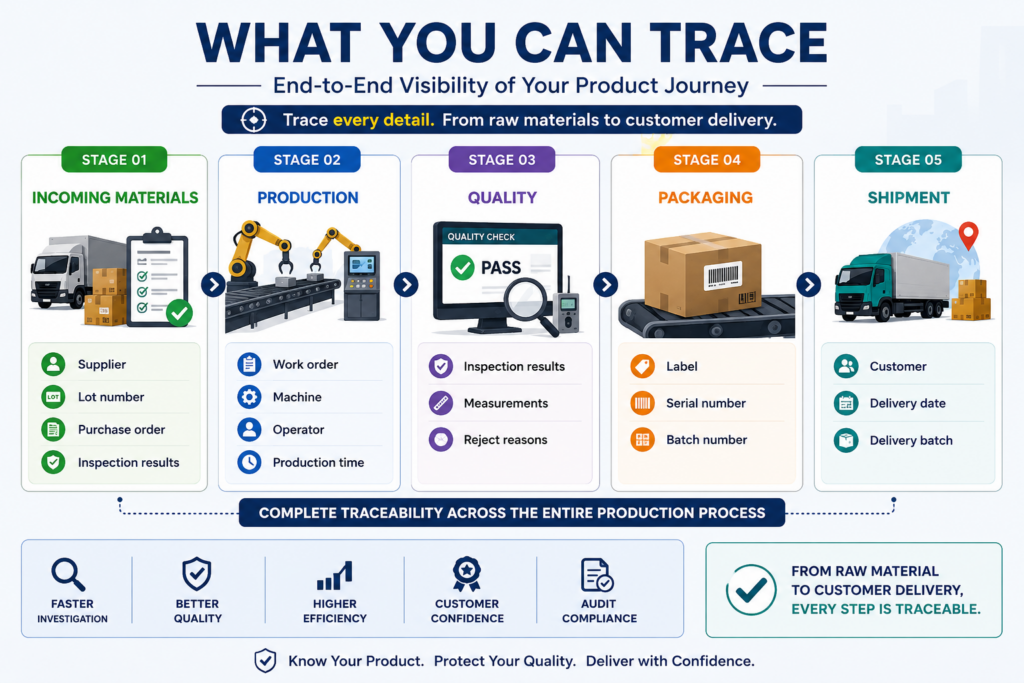
What is manufacturing traceability?
Manufacturing traceability is the ability to track and trace every product across the entire production process — replacing paper documents with records that capture what happened, on which machine, by whom, and with which materials.
When a quality issue surfaces, you can identify the affected batch, the customers who received it, the machine and operator involved, and the raw materials used — immediately.
Track Every Step of the Product Journey
A modern MES follows the product through every stage of the process, in order — from the first incoming material to the delivered shipment.
Benefits of MES Traceability
Faster product recall
Identify affected batches quickly and narrow the scope before it spreads.
Lower operating costs
Reduce paperwork, duplicate entry, and manual reporting.
Real-time production visibility
Monitor production status instantly, across every line.
Complete audit trail
Maintain electronic production records ready for compliance review.
Better product quality
Detect problems before they escalate into rejects or returns.
Improved customer confidence
Provide accurate traceability information whenever it's required.
From manual records to paperless production
Start lightweight and paperless, or go straight to a connected, predictive factory. Both run on the same traceability foundation.
Learn more eMES vs sMES →Ready to Modernize Your Factory?
Whether you are planning your first digital transformation initiative or scaling an existing smart factory, Sciengate Automation delivers practical, scalable, and future-ready industrial solutions tailored to your manufacturing goals.
Our Expertise
- Manufacturing Execution System (MES)
- System Integration
- PLC Programming
- SCADA Development
- Industrial IoT (IIoT)
- Real-Time Data Collection
- OEE Monitoring
- Predictive Maintenance
- Digital Transformation Consulting
Practical Manufacturing Digitalisation
Whether you are planning your first digital transformation initiative or scaling an existing smart factory, Sciengate Automation delivers practical, scalable, and future-ready industrial solutions tailored to your manufacturing goals.
Manufacturing Execution System (MES)
Production digitalisationSystem Integration
Connected manufacturing systemsPLC Programming
Industrial automationSCADA Development
Real-time monitoringIndustrial IoT (IIoT)
Connected factory dataReal-Time Data Collection
Production visibilityOEE Monitoring
Performance monitoringPredictive Maintenance
Equipment intelligenceDigital Transformation Consulting
Factory digitalisationFrequently Asked Questions (FAQ)
1) What is manufacturing traceability?
2) Why is manufacturing traceability important?
3) What industries need traceability?
4) What is the difference between traceability and MES?
5) How long does it take to implement an MES?
Discover your factory's digitalisation potential
Request your free consultation and receive a complete picture of where your factory stands — and what to do next.
Request a Free Consultation →